Thoughts from the Kepler
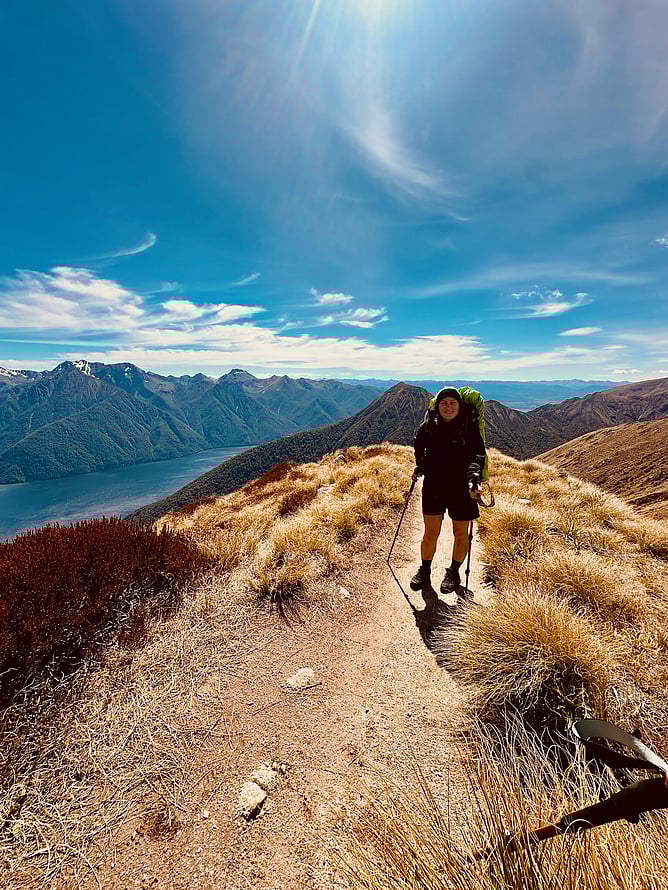
My family completed the Kepler Track in early January. It’s one of New Zealand’s Great Walks, and the first one we have done together. Three days, two nights, 45km, 1,500m climbed and descended, with everything we needed on our backs.
We knew it would test us. It had the potential to knit us closer together or, frankly, pull us apart. Thankfully, it did the former. As we walked across what often felt like the top of the world, the following reflections began to surface.
1) Sometimes the wrong way is the right way
Choosing the unconventional path can lead to unexpected benefits—more space, more clarity, and connections you may never have otherwise made. The popular route isn’t always the right route for you.
We walked the Kepler the “wrong way” because a steep incline is easier on bad knees than a steep descent. I doubted the decision at first. Why wasn’t anyone else doing this? What did they know that we didn’t? Comparison is a tricky beast, especially when you’re walking against the grain.
In the end, it was the best choice we could have made. Not only was the ascent easier on our joints, but starting with the 24km day rather than ending with it proved to be a gift. More importantly, we often walked in peaceful isolation—just our family and the track. Those moments of unity with nature are rare. And to top it off, the one person travelling in our direction became a lifelong friend whom our children adored. Unconventional can be magical.
2) Perspective matters
When you can’t see what’s ahead, the mind fills the gaps—usually with worst-case scenarios. Clarity of direction, whether in life, work, or relationships, makes adversity easier to manage.
The 1,000m ascent through dense forest offered no view of what lay ahead. It was mentally tough to climb with no sense of progress. For Visual Spatial Learners—about 30% of us—this is particularly challenging; a big picture is a necessity.
Walking blind, your mind creates stories: You can’t do this. It’s too far. You’ll never make it. It tries to protect you, but becomes the unhelpful, helpful friend.
In life, the same is true. Values, goals, and direction give us perspective. Without them, everything feels harder than it is.
3) Experience counts — “Education and experience are a loop – a mutually reinforcing process” (Ryan Holiday)
Knowledge and experience reinforce each other. Often you truly learn by doing, and every challenge adds a tool to your inner toolbox for the next time things get tough.
We can teach children about the beauty of the natural world, but watching them stand on a mountaintop, taking in its scale and majesty, showed me that actually experiencing it is entirely different. Their wonder reminded me not to take our own backyard for granted and to remember to truly see, not just look.
My own experience surfaced too. I sensed we were nearing the top of the climb through dense forest long before the kids could—shifts in wind, light, and trees told me.
Life has also taught me about my inner strength. I’ve dug deep before. I know I can. That experience let me say to my mind, “Thanks, old friend. I know you’re trying to protect me, but I’ve done harder things.”
The word learn contains earn for a reason. You earn confidence through experience. Each challenge builds your mental fitness for the next one—and this trek gave our children another reference point for the moments when their minds whisper, You can’t.
4) Choose the carrot, not the stick
Support moves people forwards far more effectively than criticism or pressure. Encouragement builds resilience; harshness breaks it down.
Imagine a dog that suddenly refuses to walk. You can yell or pull—and maybe it will move, but you’ll damage trust. Or you can sit, offer shade, water, reassurance, and then continue. Both paths may get you home, but only one leaves the dog whole.
Humans are no different. Each of us had a moment on the trek when the mind said, “I can’t”. In those moments, the last thing anyone needs is someone else piling on. Recognising the struggle, offering empathy, and—as Brené Brown says—climbing down into the hole with them keeps us intact while still getting us where we need to go.
5) Fear sits behind many reactions
When fear takes the wheel, it drives defensiveness, judgement, and reactivity. Naming fear puts you back in charge of your actions.
Fear is a key driver behind many of our actions. When we recognise it, we’re more able to stay open, curious, and act with integrity. When we don’t, fear takes the wheel — and that’s when we become defensive, reactive, or overly focused on self-protection.
In those moments, I’ve noticed I can slip into the “villain” role — blaming, judging, criticising. Others might move into the “hero” role, trying to carry everything themselves, or the “victim” role, feeling powerless and overwhelmed. It’s a pattern explored in the “above and below the line” work that Brené Brown highlights in Strong Ground (well worth a read if you haven’t already).
Above the line, fear is still present, but we’re able to harness it. Below the line, fear is very much in charge — and below-the-line behaviour isn’t much fun for anyone involved.
The Kepler made this visible. All of us dropped below the line at times. What helps? Noticing it, naming it, pausing, and choosing your next step with intention. And often, what makes that possible is the people around us — because humans genuinely need humans (more on that next).
6) Humans need humans
Even the strongest, most independent people need connection. A supportive word, a shared direction, or simply being alongside someone can make a difficult stretch feel manageable.
When I was overwhelmed with the pre-trek organisation and planning (it really is a military-level operation), my daughters helped calm me down. They reminded me why we were doing the trek and helped reframe my anxiety and overwhelm into excitement. Equally, when they struggled with fatigue or pain, we were able to give them the support they needed to keep going.
Speaking with other walkers travelling alone, it was clear the challenging moments were easier when they paused to talk to those coming the other way — How much further? What’s ahead? We are wired to need each other.
7) Pace is personal
Everyone moves at their own speed for their own reasons. Respecting those differences creates stronger teams—on the trail and in life.
We quickly discovered that we all walk at different paces, and usually for reasons rooted deeper than the trail itself. Some of us naturally moved to the front — drawn by the freedom of open space ahead and the feeling of not being enclosed or slowed by someone in front. Others gravitated towards the rear, finding comfort in taking in the landscape and keeping an eye on the group stretched out ahead.
It struck me how recognisable these patterns were — the people who feel most themselves with open space in front of them, the natural leaders, the observers, the quiet protectors. And while these tendencies held true, they weren’t rigid. At different times, different people stepped forward or dropped back depending on energy, terrain, or simply how they were feeling in the moment.
What mattered was that we didn’t try to force a single rhythm or pace. We allowed each person to walk the way they needed to walk, and within the broader shape of the team, those differences complemented one another. Our varied paces didn’t slow us down — they strengthened us.
8) Movement keeps the niggles at bay
Physical activity doesn’t just strengthen the body; it steadies the mind, reduces friction, and supports relational harmony.
Physical activity doesn’t just affect the body; it has a remarkable way of diffusing boredom and frustration. And when those two are kept in check, everything else feels a little easier — interactions, patience, and even the moments when things get tough.
On the Kepler, we walked for hours each day. Our bodies were constantly engaged, whether we were climbing, navigating uneven ground, or simply keeping pace. Because our energy was being used, the usual sparks of boredom or frustration barely appeared. Movement filled the space where they normally creep in.
It made me realise how important exercise is — not just as a health practice, but as something that steadies families, tempers emotions, and gives everyone an outlet. The track reminded us that when our bodies are moving, our minds and relationships move more easily too.
9) Untethering reconnects you
Stepping away from devices and daily noise, even briefly, sharpens awareness and strengthens connection to the world around you.
For three days we had no phones, no messages, no news about the dire state of the world. We disconnected. And, as the saying goes, we reconnected in the process — with each other, and with the world around us.
We walked through some of New Zealand’s finest forests, half expecting Galadriel’s elves to appear between the trees. We noticed the countless shades of green on the leaves — so varied, so vivid, so breathtakingly beautiful.
We recognised how generously nature provides: the forest canopy acting as an umbrella, sheltering us from the elements at just the right moments.
We talked. We were silent. We supported each other. And without the distraction of devices — myself and my husband included — we were fully present in a way that felt rare and valuable.
Disconnecting allowed us to truly reconnect.
The Kepler demanded effort, presence, and teamwork — and gave us lessons we’ll carry long after the trail ended. Hard, beautiful things often do.